
Dear Manchán - 2
A letter about the stories we tell

January 3, 2024
Dear Manchán,
I was delighted to find your letter; a thin envelope from Ireland amid the typical collection of credit card solicitations, and those catalogs that insist winter holidays are a good reason to trade money for stuff. After depositing that clutter into the burn barrel—conveniently located ten steps up the path from the mailbox—I cut a slit past the deliciously foreign-looking stamp and unfold your letter. Thank you for being willing to exchange ideas about land and water via pen on paper. Having read your words, I now understand Ireland’s place in the cyclic dance of life and ice as they have traded places over and again across the Northern Hemisphere. It is her ecological austerity, as you highlight, that intrigues me. But as you also point out, we see but the latest cloak of life—those that came before were scrubbed clean from the rock by previous ice ages.
This morning I kindle a fire and light the oil lamp in my study, pushing the darkness out to sulk behind the clutter. On my desk, in addition to the typical untidy collections of paper, books, and hard drives, there is a vertebrae. It is old and weathered—a lumpy gray backbone about the size of my fist. This object was first a working part in a large mammal, then a cast-off scrap from a meal. Then I plucked it from loose sand where the ocean was eroding the earth. Around the earthen depression from which it had tumbled were the ash and char of old cooking fires, husked shells, and round rocks with blackened sides. I saw no other bones.
This was a place people lived before history; where the crash of surf fragmented human voices as their murmured stories dissipated into the darkness that loitered at the edge of the firelight.
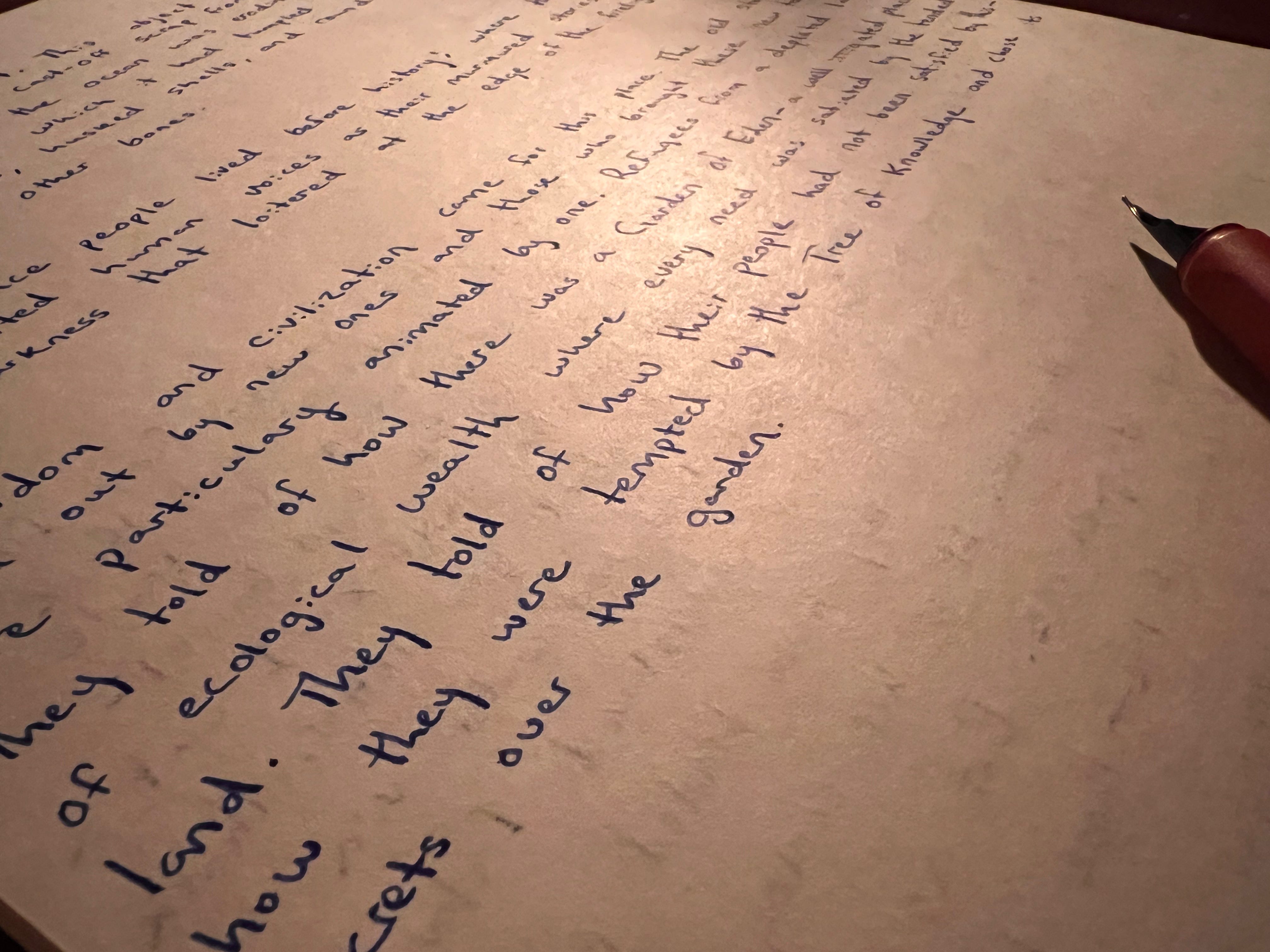
Christendom and civilization came for this place. The old stories were edged out by new ones and those who brought these new tales were particularly animated by one. Refugees from a depleted land, they told of how there was a Garden of Eden—a well-irrigated place of ecological wealth where every need was satiated by the tended land. They told of how their people had not been satisfied by this—how they were tempted by the Tree of Knowledge and chose its secrets over the garden. How they entered their heads then, time started, and without the Garden of Eden, they were forced to survive through their own ingenuity.
As a species, we emerged from the middle of Africa and found that Garden of Eden to our north—a landscape of wetlands teaming with plants and wildlife. Most of our existence as humans was lived happily in this garden—we ignored that tree of schemes and notions for a long time. The humble custodians of this garden taught us about building shelters from wood and clay; they’d already been doing it for a very long time. As we hunted and gathered, we took inspiration too from how they deftly engineered the ecosystem and we began to use fire in much the same way that beavers were using water; stewarding the habitat for us and what we eat. Life came to expect our tending with fire, just as it evolved with beavers managing the freshwater.
We were sibling races of beings—us and the beavers.
This too is but a story, which I write now by lamplight as dawn grays the land. I believe that the tale of Eden is a story older than Christendom, a confession handed down from ancestors who chose farming and civilization at a steep cost; they were disconnected from the garden of water and life. I think the other bits of this story—the festering resentment of the wild and of women, the insistence that we are forever banned from going back—are later additions… Justifications for our isolation by a needy civilization that takes to survive.
As a species, how do find our way back to the garden? As a man, I can’t help but think of this challenge as a quest, but I suspect the path lies in a deference to the wisdom of women, the land, and indigenous stories that are still told—some even, perhaps, by firelight.
Jakob
What! You didn't recycle 😉